

From measurement to meaning: ISICO’s Award-Nominated research at SOSORT 2026
When the international scoliosis community gathers in Turin, Italy, from 29 April to 2 May 2026 for the SOSORT International Congress, ISICO will be present with a rich and multifaceted scientific contribution.
Alongside the abstracts previously announced, an additional study —“A 3D Surface Topography-Derived Method for the Aesthetic Evaluation of Trunk Asymmetry in AIS” — has also been accepted for poster presentation, further expanding ISICO’s contribution to the congress (a total of 23 abstracts: 19 oral presentations and 4 poster presentations).
Among this body of work, two studies have been selected to compete for the prestigious SOSORT Award. Both focus on a theme that lies at the heart of conservative treatment for adolescent idiopathic scoliosis (AIS): aesthetic outcome. Not only how we measure it. But how patients experience it.
TRACE2: bringing precision to clinical aesthetic evaluation
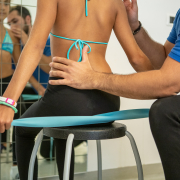
The SOSORT Award nominee “TRACE2 (Trunk Aesthetic Clinical Evaluation, Version 2). The New Rasch-Compatible Scale to Enhance Aesthetic Evaluation in Clinical Practice and Research” represents a significant methodological evolution, aligning clinical observation with psychometric robustness. Aesthetic improvement is formally recognized by SOSORT as a primary goal of rehabilitation in adolescent idiopathic scoliosis (AIS). Yet, measuring aesthetics in a reliable and reproducible way has always been challenging.
TRACE has long been part of everyday clinical practice. With TRACE2, ISICO takes a decisive step forward. Developed through an international Delphi process and validated using Rasch analysis — the gold standard in modern psychometrics — TRACE2 expands the original 4-item scale to 13 items while preserving clinical practicality.
The new version increases measurement sensitivity and reliability, allowing clinicians to discriminate trunk asymmetry more precisely and to compare outcomes across patients and populations with greater confidence.
TRACE2 does not complicate practice. It strengthens it. As Stefano Negrini, ISICO Scientific Director and first author of the study, explains: “We have always known that aesthetics matter deeply to our patients. TRACE2 allows us to measure trunk asymmetry with the rigor required by modern psychometrics, without losing the simplicity needed in daily clinical work”.
Watch the short video in which Stefano Negrini presents TRACE2.
When improvement is visible — but not yet felt
The second SOSORT Award nominee, “Early Clinical Improvement, Delayed Patient Perception: Divergent Aesthetic Outcomes During Brace Treatment for Adolescent Idiopathic Scoliosis” explores a crucial and often overlooked dimension of conservative treatment: the relationship between measurable improvement and patient perception.
In a large cohort of 1,004 adolescents treated with rigid and very rigid “push-up” braces, clinician-assessed trunk aesthetics (TRACE) improved significantly within the first four months of treatment. Objective changes were clear, early, and statistically robust.
Patients, however, did not perceive a comparable improvement until the end of treatment, as reflected in the SRS-22 self-image domain.
This temporal divergence between objective aesthetic correction and subjective self-perception highlights an important clinical reality: physical changes and psychological adaptation do not necessarily evolve in parallel.
The findings suggest that clinicians should not assume that measurable improvement automatically translates into perceived benefit. Instead, actively sharing objective results during treatment may enhance patient awareness, motivation, and possibly adherence.
As Francesco Negrini, rehabilitation physician at ISICO reflects: “We often assume that when the body improves, the patient immediately feels better. Our data show that this is not necessarily the case. Recognizing and addressing this gap may help us improve communication and support patients more effectively throughout treatment”.
This study deepens our understanding of the patient experience during bracing and reinforces the importance of integrating objective assessment with patient-reported outcomes in everyday clinical care.





Leave a Reply
Want to join the discussion?Feel free to contribute!