
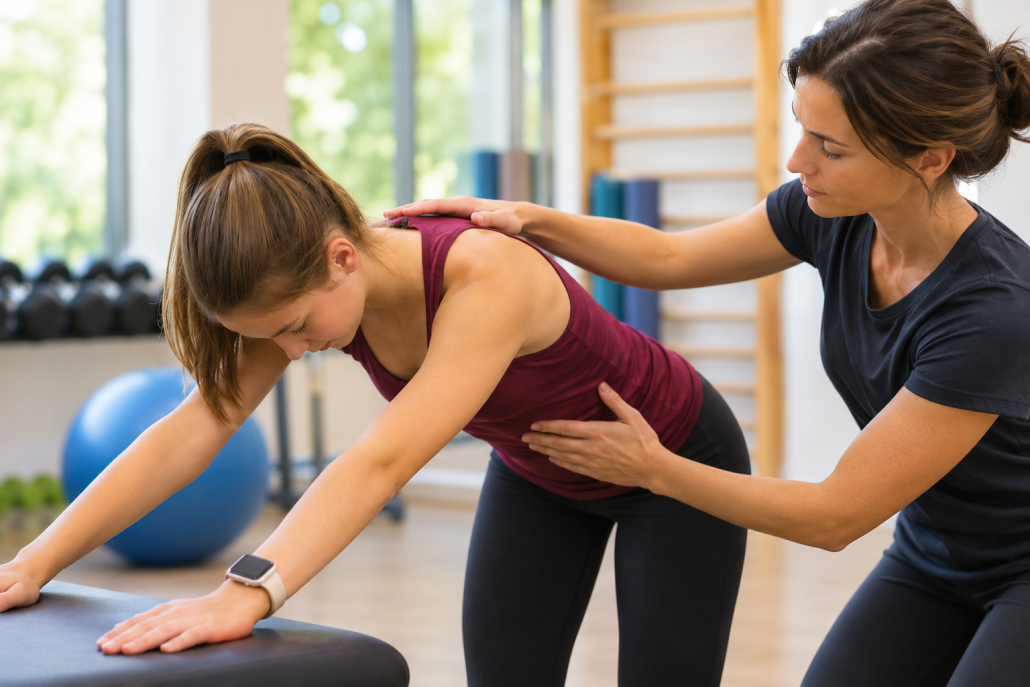
Sport and Hyperkyphosis: is swimming really good for your back? What about weight training?
Which sport should you choose if you have an excessively rounded back? Is swimming really the best option? And can weight training make the condition worse? Alessandra Negrini and Luca Selmi, ISICO physiotherapists, help us debunk some common myths.
“My child has a rounded back. Which sport should they do?” This is a question parents often ask specialists. Some immediately think of swimming, traditionally considered the ideal sport for back health. Others worry that cycling might increase the spinal curvature, while some are concerned about exercising in the gym.
But what does the science actually say? First of all, it is important to understand that the shape of the back varies considerably from one adolescent to another. In a study involving 847 healthy 14-year-olds, thoracic kyphosis ranged from 6 to 69 degrees. Therefore, a back that appears more rounded is not necessarily a sign of a spinal disorder. Sport is important for overall health and improves muscle strength, but there is insufficient evidence that it can correct hyperkyphosis on its own.
Can Sport Correct Hyperkyphosis?
For decades, swimming has been considered the sport of choice for people with spinal problems. However, as early as 2015, a study conducted by ISICO researchers and published in The Journal of Pediatrics challenged this long-held belief.
The study, which compared 112 adolescent competitive swimmers with 217 peers, found a higher prevalence of trunk asymmetries among swimmers and a 2.26-fold greater likelihood of presenting with hyperkyphosis.
Similar findings emerged from another study, published in PeerJ in 2022, which found that young swimmers had, on average, 3.8 degrees more thoracic kyphosis than non-swimmers.
Does this mean that swimming makes kyphosis worse? Absolutely not.
“The problem is that these are cross-sectional studies, meaning they provide a snapshot at a particular point in time,” explains Alessandra Negrini. “They cannot establish whether practising a sport influenced spinal curvature or whether adolescents who already had more pronounced kyphosis were more likely to choose swimming.”
Furthermore, the differences observed are very small. The surface measurement instruments used in these studies have a measurement error of 3–6 degrees, meaning that the additional 3.8 degrees observed among swimmers fall within this margin.
Swimming, therefore, cannot be considered a treatment for hyperkyphosis, but neither should it be avoided on the basis of the current evidence.
Researchers have also examined other sports, including cycling, tennis, basketball, volleyball and gymnastics, without identifying any discipline capable of correcting hyperkyphosis.
The literature shows that participating in sport improves trunk muscle strength, but does not demonstrate a similarly significant effect on spinal shape or kyphotic mobility.
“Sport makes you stronger, but not necessarily straighter,” Negrini points out. “This is where the distinction between sport and specific therapeutic exercises becomes clear. These exercises are individually tailored to address the characteristics of the spinal curvature and improve a person’s ability to control and modify spinal position. Sport is therefore an important complement, but it does not replace treatment in cases of structural hyperkyphosis.”
Growth has a greater influence on kyphosis than sport. Thoracic curvature naturally increases with age, by approximately 2–8 degrees, with the most significant changes occurring between the ages of 10–12 and 13–15. This is therefore an important period for monitoring spinal development through regular specialist assessments.
What About the Gym? Is Weight Training Safe?
Another common misconception concerns gym-based exercise, which is often discouraged for fear that lifting weights might overload the spine or increase thoracic curvature.
“We essentially have no evidence to justify prohibiting or discouraging gym training in people with hyperkyphosis,” explains Luca Selmi. “In fact, the gym offers an important advantage: it allows exercise programmes to be personalised, adapting movements and loads to each individual’s characteristics.”
The approach recommended by our physiotherapist is to first learn how to control movements of the thoracic spine and shoulder blades correctly, before gradually progressing to muscle strengthening. This is not simply about stretching or trying to lengthen muscles that appear tight. It also involves restoring movements that are rarely performed, improving coordination and learning how to control the body correctly during exercise.
Even training the pectoral muscles, which is sometimes avoided for fear of encouraging a forward-rounded posture, is not necessarily contraindicated. What matters is ensuring proper technique and adapting exercises to individual abilities, avoiding compensatory movements and gradually increasing the level of difficulty.
This approach can also be integrated into gym-based training programmes for people with spinal conditions. Physical activity does not replace specific therapeutic exercises, but can complement them and contribute to overall well-being.
The Best Choice? Keep Doing the Sport You Love
If no sport can correct hyperkyphosis on its own, there is also no reason to automatically require an adolescent to give up the sport they practise, even at a competitive level.
“Preventing a young person from practising a sport is always painful,” observes Alessandra Negrini. “For some adolescents, being able to continue their favourite sport is an important motivation for accepting a demanding treatment, such as wearing a brace. We must not forget how important sport is for social interaction and friendships: imposing an unnecessary change may lead a young person to give up physical activity altogether”.
The choice of sport should therefore take into account the individual’s clinical condition, any ongoing treatment and the specialist’s recommendations, avoiding unjustified restrictions that could also have consequences later in adulthood.
The key message is clear: rather than choosing a sport in the hope that it will straighten the spine, we should encourage activities that young people enjoy and can practise consistently, alongside specific treatment for hyperkyphosis when necessary.

Leave a Reply
Want to join the discussion?Feel free to contribute!