
Posts

From Patient to Physiotherapist: Simone’s Story

Turning a difficulty into a resource, and a vulnerability into a life choice.
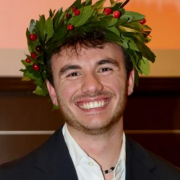
This is the story of Simone Priano, a former ISICO patient, who has recently graduated in Physiotherapy from the University of Novara, in north-western Italy, with a final mark of 108/110, defending a thesis focused on scoliosis and scoliosis-specific exercises for its treatment.

A topic that was anything but coincidental.

“It is often said that one should turn weaknesses into strengths. Fortunately, I have turned mine into my profession,” Simone explains. “Today I celebrate my graduation in Physiotherapy with a thesis on scoliosis. This subject is deeply personal to me because it is thanks to my experience as a former patient that I am here today. Bringing it to my final thesis was my way of honouring that journey and closing the circle.”

Simone began his therapeutic journey as an adolescent, while attending the ISICO centre in Turin and playing volleyball. He was diagnosed with scoliosis with a significant curve, requiring a demanding course of conservative treatment: 23 hours a day wearing a brace, combined with specific exercises. His treatment lasted five years, from September 2016 to June 2021.

Initially, however, his experience was not positive. Treated elsewhere, he had been told that conservative therapy would be ineffective and that surgery was the only possible option — a prospect that could have discouraged anyone. Instead, Simone encountered a different approach, based on consistent, structured work and a strong therapeutic relationship.

“He was already a serious and determined young man during his treatment,” recalls his ISICO physiotherapist, Martina Poggio. “Being able to support him later during his thesis work was an immense pleasure for me. Through therapy, we accompany young patients throughout their growth, often for many years, and inevitably form a bond with them. Seeing them again as adults — confident, aware and fulfilled — is truly special.”

The relationship did not end with the conclusion of treatment. On the contrary, it evolved into professional dialogue and scientific collaboration.

“The fact that he chose the same professional path and career means that, despite the evident challenges of therapy, he was able to go beyond them, finding motivation and support to overcome the condition. He is the second former patient whom I have met again, years later, as a colleague.”

Today, Simone is a young physiotherapist whose training combines academic study with direct personal experience — a valuable perspective that enriches both his clinical practice and his human approach to patients.

“I wish Simone a brilliant future,” his former physiotherapist concludes, “with the certainty that he will be able to pass on to other young people what he himself has experienced: that even a difficult journey can become a source of strength.”
My brace: my friend ….my enemy!

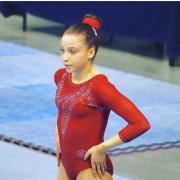
Aurora, 15 years old, shares with us her experience with the brace.

“I wasn’t born with scoliosis. My problems began when I was ten years old, and our doctor noticed that my back wasn’t quite as straight as other people’s.

On his suggestion, I had an X-ray that confirmed that I had a scoliotic posture, which corrective exercises could correct. So, I had a few sessions with a posturologist and learned how to do the necessary exercises. My posture improved, and that seemed to be the end of it.

Since I do artistic gymnastics at a competitive level, I often have checkups with a physical therapist, and on one occasion, it was noticed that I had a twisted hip.

We talked this over with my doctor — I was 12 by this time —, and it was decided that I should have another X-ray, which showed up a very mild scoliotic curve, measuring just a few degrees, that needed to be monitored.

I continued doing my sport as usual until, at the age of 13, I started getting a strong pain in my lower back, towards the hip area. It gave me a lot of trouble throughout that year’s artistic gymnastics championship. It was such a strong, searing pain that I had to wear an elastic sheath around my back for support when training and competing. But I never gave in!

I had various tests to try and get to the bottom of this pain, and it was discovered that my scoliosis had got a lot worse, with the curve increasing from just a few degrees to more than 30° in the space of just one year. My spine now had a marked “S” shape that started at hip level and even affected one shoulder blade. The scoliosis was so bad that I had to start wearing a brace without delay.

There were several tests and procedures to go through in order to get the brace, and I received my first one when I was 14 years old. I had to wear it for at least 18 hours a day.

To tell the truth, I wasn’t particularly concerned about the prospect of wearing a brace, partly because I didn’t really know what it entailed. My immediate concern was that I would have to give up my artistic gymnastics. I couldn’t bear that thought! However, as soon as I had been reassured and put this fear behind me, I was ready to start my bracing treatment.  

The first week I really hated it and regarded the brace as an enemy. I couldn’t do the simplest thing! I couldn’t stand comfortably, and it impeded me in everything: I couldn’t put my clothes on or tie my laces, or do so many of the everyday things you normally don’t think twice about. I was really mad! Mad about having scoliosis, about having to wear a brace, and about having to put up with all that pain and discomfort. Why did it have to be me?!

Before long, though, I calmed down and accepted the situation. I was going to have to wear the brace in any case, so there was no point getting mad about it.

My gymnastics helped me a lot in this sense, first of all, because this discipline had helped me, from a young age, to get used to coping with pain and having to make certain sacrifices, and second because it was my only outlet.

When I was training or doing competitions, I would take the brace off and then put it back on again as soon as I had finished.
I have to admit that, to begin with, I felt a bit uncomfortable and embarrassed about wearing it, but those feelings soon disappeared, because I tend not to worry too much about what other people think, and just try to feel good about myself.

I’m 15 years old now, and I have already been wearing a brace for more than a year.

I have had three braces so far, having had to change them frequently due to my growth. Apart from a little pain at the beginning each time as I get used to the new “shell”, it’s all pretty straightforward and easier than before. Now, I can get dressed by myself, do up my own shoes, and so on. Basically, I don’t need anyone’s help.

There is always a degree of discomfort, that doesn’t disappear completely, but now I see my brace as a friend, not an enemy: a friend that is there to help me to solve a problem, to prevent me from getting worse, and to try and make sure that I end up with a straighter back and more attractive silhouette.

So, basically, I have learned to get along with my brace. We are so close (literally!) that I have even given it a name: Dori. I am actually grateful to it because, together with my sport, it is helping me to develop a beautiful physique and a definite waistline (which I didn’t have before). Having said that, quite often I still fall out with it and really can’t stand it!

I have learned to dress in a way that hides my brace as far as possible. I have bought new, more suitable clothes and they help me feel good about myself too!

Nearly a year has gone by now, which is great!

I still don’t know how long I am going to have to wear my brace for, as I still have some growing to do. I guess it will still be some time before I’m done.  I hope that reading about my experience has helped and reassured you, and will encourage you to tackle your own long journey with commitment and determination, just as I am doing. I want to end on a positive note: there’s light at the end of every tunnel, so don’t despair!

All the best… hang in there!”

Aury Gymnastics