Back pain and menopause: why posture changes after 50 and how to protect your spine
We often tend to think of scoliosis as a condition linked exclusively to adolescence, those growing years when parents constantly reminded us to “stand up straight”. However, there is a lesser-known yet very common reality: scoliosis that appears or worsens in adulthood, often during a delicate stage such as menopause. If, after the age of 50, you have started to notice persistent lower back pain or changes in your posture, you are not alone. Understanding what happens to our spine is the first step towards continuing to move freely and confidently.
“De novo” scoliosis: a new challenge after 50
There are two ways scoliosis may present in adults. Some people have lived with a spinal curve since their youth, which may become symptomatic again over time.
For many others, however, what doctors call “de novo” scoliosis develops. As the name suggests, this is a completely new curvature that appears in people who previously had a well-aligned spine. It is not caused by abnormal bone growth, but by the natural wear and tear of the structures that support the back. In most cases, this form affects the lower back (lumbar or thoracolumbar region) and presents with gradual postural changes associated with pain.
At the root of the condition are asymmetrical degenerative changes: the intervertebral discs thin unevenly, the joints between the vertebrae lose stability, and muscles and ligaments become less efficient. This creates an “asymmetrical load”: the spine tilts, weight distribution becomes uneven, and a vicious cycle begins, accelerating degeneration and progression of the curve. Over time, these changes may also lead to a reduction in the normal lumbar curvature (lordosis) and, in some cases, to small vertebral slippages or narrowing of the spinal canal.
Why women in particular? The role of menopause
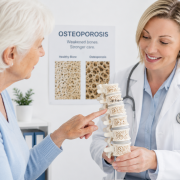
Statistics speak clearly: adult scoliosis affects women more frequently and increases with age. It is estimated that prevalence rises from around 13% in people under 60 to over 30% after the age of 60, with even higher rates among older populations. With the onset of menopause, the body undergoes a true hormonal revolution that affects bone mineral density (osteoporosis), ligament elasticity, and muscle tissue quality. But it is not only a matter of more fragile bones.
The higher prevalence in women appears to result from a complex combination of factors: disc degeneration, osteoarthritis, ligament laxity, and muscular changes, which together make the spine more vulnerable to these small structural “failures”.
What can you do today for your back?
The good news is that we are not passive spectators when it comes to the health of our spine.
Stay active
Exercise is your greatest ally. Intense activity is not necessary: the important thing is to counteract sedentary habits and loss of muscle mass (sarcopenia). Strong muscles support the spine like a true “natural corset”.
Self-correction exercises
If scoliosis causes asymmetries or pain, modern physiotherapy offers very effective tools. Specific exercises teach the body to regain balance and improve posture actively. In particular, SEAS self-correction exercises have been shown to be effective in improving or slowing the progression of adult scoliosis.
Listen to your body’s signals
Do not ignore persistent pain, tingling in the legs, or difficulty walking for long periods. In more advanced cases, symptoms related to nerve involvement may appear, such as radiating pain (radiculopathy) or reduced walking tolerance (claudication). In these situations, it is important to consult a specialist. By carrying out daily home exercises aimed at improving trunk support, it is possible to reduce the impact of spinal degeneration on both pain and quality of life.