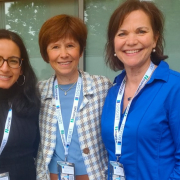
International guests at the ISICO clinic in Vigevano
The ISICO clinic in Vigevano recently welcomed two international guests from New York: physiotherapists Prachi Bakarania and Gail Fennell, both certified in SEAS Level 1 and Level 2.
The visit was coordinated by ISICO physiotherapist Alessandra Negrini, who guided the two colleagues through the clinical activities carried out at the centre. Prachi Bakarania is also Secretary of SOSORT and a member of the Society’s board.
We asked both guests a few questions about their experience with SEAS and their visit to ISICO.
Scoliosis: how is it treated in your country?
Gail Fennell: “Our treatment is similar to yours. Patients often seek us out directly. We do receive referrals from MDs, but very often it is the family who finds us for care. Our evaluation process is also quite similar. I really appreciated the app you use to guide patients with their home exercises. We use videos on patients’ phones and printed instructions, but your system seems even easier for patients to follow”.
Prachi Bakarania: “Similarly to your system, patients are diagnosed with scoliosis by an MD or RN and then referred for bracing. Physiotherapy specifically dedicated to scoliosis is still developing, and often patients have to advocate for themselves in order to access a scoliosis physiotherapist”.
Are you satisfied with what you learnt during the SEAS courses? What impact has this training had on your daily clinical practice?
Gail Fennell: “Yes, absolutely. I use what I learned in the SEAS courses every day in my clinic. I especially appreciate the balance and coordination exercises aimed at neurological integration.
Prachi Bakarania: “Very satisfied. I loved SEAS — it truly changed the way I treat patients. I integrated what I learned in SEAS with my previous education and clinical experiences, and I feel it has made me a stronger physiotherapist.”
What was your experience visiting the ISICO clinic in Vigevano?
Gail Fennell: “It was a wonderful opportunity to observe Alessandra’s expertise in evaluating patients and prescribing exercises directly in her clinic. The visit was both a confirmation and a reminder of the principles of SEAS treatment and how they can be adapted to each individual patient. She demonstrated how important it is to understand not only the patient physically and emotionally, but also the entire family context when planning home exercises and brace treatment”.
Prachi Bakarania: “Watching Alessandra do what she does best was incredible. Her ease with patients and her ability to understand not only the patient, but also the family, was amazing. It was also very interesting to see how many similarities there are with my own clinical practice, while at the same time learning new ideas that I cannot wait to apply in my clinic. The trip was absolutely worth it”.